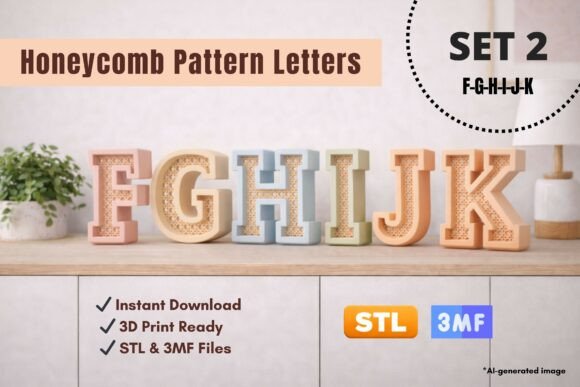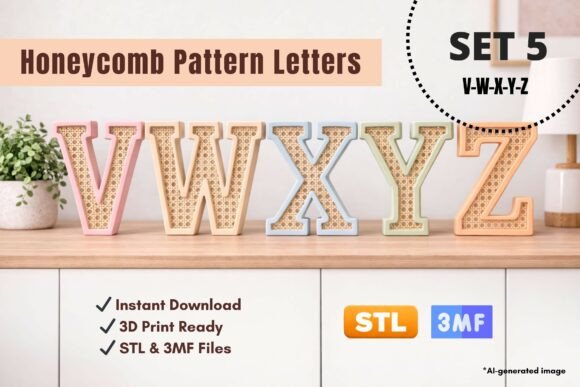
Elevating Personal Branding with Honeycomb Pattern Letters SET 5
In an era where physical presence and digital identity increasingly intersect, the demand for unique, tangible assets has never been higher. For creators, small business owners, and design enthusiasts, the ability to produce high-quality, customized decor is no longer a luxury reserved for those with industrial manufacturing access. It is a capability now sitting on many desktops, driven by the accessibility of 3D printing technology. At the forefront of this shift are specialized design assets like Honeycomb Pattern Letters SET 5, a collection that bridges the gap between functional typography and artistic expression.
This specific set, covering the alphabet range from V to Z, represents more than just a digital file; it is a tool for personalization in a mass-produced world. Whether used for crafting bespoke name signs for a home office, creating distinctive branding elements for a retail space, or producing thoughtful personalized gifts, these letters offer a stylistic edge that standard fonts simply cannot match. The integration of a stylish pattern interior design transforms what could be a flat, utilitarian object into a piece of art that plays with light, shadow, and texture.
The Evolution of Custom Decor and the Maker Economy
The landscape of home decor and professional branding has undergone a significant transformation over the last decade. Consumers have moved away from generic, big-box store items toward pieces that tell a story or reflect individual identity. This shift aligns perfectly with the rise of the "maker economy," where individuals leverage technology to create products that were previously only available through custom commissions.
Within this context, 3D printable alphabet letters have evolved from simple, blocky prototypes into sophisticated design elements. Early 3D printed text often suffered from visible layer lines and a lack of structural elegance. However, modern designs like the honeycomb lattice pattern address these aesthetic concerns directly. The honeycomb structure is not merely decorative; it is a nod to engineering efficiency, offering strength with minimal material usage. When applied to typography, it creates a visual depth that changes depending on the viewing angle and lighting conditions, adding a dynamic quality to static objects.
For professionals such as marketers and bloggers, this evolution offers a new avenue for content creation and brand differentiation. A video background featuring a 3D printed logo with an intricate internal lattice captures attention far more effectively than a flat graphic. Similarly, educators and freelancers can use these tools to create tactile learning aids or unique office signage that reinforces their personal brand identity without incurring the high costs of traditional fabrication methods.
Design Mechanics: Why Structure Matters
The efficacy of any 3D printed object relies heavily on its underlying geometry. Honeycomb Pattern Letters SET 5 is engineered with specific practicalities in mind. The letters are designed with thick walls, a crucial feature for ensuring durability during the printing process and in the final application. Thin-walled prints are prone to warping, breaking, or failing to adhere properly to the print bed, especially when dealing with complex shapes like the diagonals in 'V' and 'X' or the curves in 'U' and 'Z' (though this set focuses on V-Z, the design philosophy remains consistent across alphabets).
The elegant inner lattice pattern serves a dual purpose. Aesthetically, it provides a modern, tech-forward look that complements contemporary interior design trends favoring geometric abstraction. Functionally, this lattice reduces the overall weight of the letter and minimizes the amount of filament required, making the printing process more economical and environmentally friendly. Furthermore, the open structure allows for creative post-processing. Users can weave LED strips behind the letters for illuminated signage, insert colored resins into the gaps, or leave them open to cast intricate shadows on walls.
This set includes the letters V, W, X, Y, and Z. While these might seem like the tail end of the alphabet, they are frequently the most challenging to design due to their angular nature and balance requirements. A well-designed 'W' or 'Y' must maintain structural integrity at sharp junctions while preserving the visual flow of the honeycomb pattern. This level of detail ensures that when these letters are assembled into names or words, the result is cohesive and professional.
Workflow Flexibility: Navigating File Formats
One of the most significant barriers to entry for new 3D printing enthusiasts is file preparation. Recognizing this, the designer of this set has provided maximum flexibility by including two distinct file formats: 3MF and STL. Understanding the difference between these can significantly enhance the user experience and the quality of the final output.
- STL Files: These are the industry standard for 3D printing. In this set, the STL files represent complete single-piece models. They are ideal for users who want a straightforward "slice and print" workflow. If you are printing in a single color—such as a matte white for a minimalist nursery or a sleek black for a corporate lobby—the STL format is the most efficient choice. It requires no assembly and minimizes the risk of alignment errors during printing.
- 3MF Files: The 3MF (3D Manufacturing Format) is a newer, more robust format that supports additional data, including color and texture information. In this specific collection, the 3MF files come with pieces separated. This is a game-changer for advanced users aiming for multi-color prints without the need for complex painting techniques. By printing the outer shell in one color and the inner lattice in another, or by swapping filaments mid-print, creators can achieve a level of customization that mimics injection-molded parts. This separation also aids in printing support structures more effectively, ensuring cleaner finishes on overhangs.
This dual-format approach acknowledges the diverse skill levels within the community. It accommodates the hobbyist looking for a quick weekend project just as well as the entrepreneur prototyping a product line who needs precise color control.
Practical Applications for Professionals and Creators
The utility of these 3D printable letters extends far beyond simple decoration. For various sectors, they serve as versatile tools for communication and branding.
Home Decor and Personalization: In the realm of interior design, personalized touches define a space. Parents can create unique nameplates for children's rooms that grow with them, avoiding the plastic look of store-bought alternatives. Couples might use these letters to craft anniversary gifts or wedding centerpieces. The honeycomb pattern adds a layer of sophistication that elevates the item from a craft project to a decor staple.
Small Business Branding: Retailers and cafe owners often struggle to find affordable signage that looks custom-made. With a 3D printer and this file set, a business owner can produce shelf labels, window displays, or counter signage that matches their exact brand colors. The ability to iterate quickly means that seasonal promotions can be updated with minimal cost and waste.
Educational Tools: Educators, particularly those in STEM fields, can use these letters to teach concepts related to geometry, structural engineering, and design. The honeycomb pattern is a perfect real-world example of efficient natural design, seen in beehives and carbon nanotubes. Printing these letters allows students to physically interact with these concepts.
Optimizing Your Print: Realistic Expectations and Tips
While the digital model is ready to print, the physical result depends heavily on the user's hardware and settings. It is important to approach 3D printing with a mindset of experimentation and adjustment. No two printers are identical, and factors such as ambient temperature, filament brand, and nozzle wear can influence the outcome.
To achieve the best results with Honeycomb Pattern Letters SET 5, consider the following recommendations:
- Orientation Matters: Printing letters flat on the build plate usually yields the smoothest top surface. However, for letters with significant overhangs like 'Y' or 'V', you may need to adjust the angle or generate supportive structures. The thick wall design helps mitigate some warping, but proper bed adhesion is still critical.
- Support Settings: Given the internal lattice, tree supports or organic supports often work better than grid supports. They are easier to remove from the intricate inner patterns without damaging the delicate connections of the honeycomb.
- Material Selection: PLA is generally the easiest material to work with for decorative items, offering sharp details and a wide range of colors. However, if the letters are intended for outdoor use or environments with high heat, PETG or ASA might be more appropriate, though they may require enclosure printing to prevent warping.
- Infill and Walls: Since the design already features an internal pattern, you can often set the infill to 0% or very low in your slicer software, relying on the modeled lattice for structure. Ensure your wall line count matches the design intent to maintain the thickness specified by the creator.
It is essential to remember that the designer provides the digital blueprint, but the physical realization is a collaborative effort between the file and the machine. Adjusting speeds, temperatures, and cooling fans is part of the process. Patience and iteration are key to mastering these prints.
Conclusion: The Future of Tangible Digital Assets
The availability of high-quality, specialized files like Honeycomb Pattern Letters SET 5 signifies a maturing market for digital assets. As 3D printing becomes more integrated into standard workflows for creators and businesses, the value shifts from the hardware itself to the quality of the designs we choose to print. This set exemplifies how thoughtful design can transform a basic utility into an object of beauty and function.
Whether you are a freelancer looking to distinguish your workspace, a marketer seeking eye-catching props, or a hobbyist exploring the limits of your printer, these letters offer a practical and stylish solution. They remind us that in a digital-first world, there is still profound value in holding something real, something crafted with intention, and something that bears the unique imprint of the creator. By leveraging tools like these, we not only decorate our spaces but also participate in the ongoing evolution of how things are made.