Evaluating the Jivin Jukebox SVG for Professional Paper Crafting
For professionals and serious hobbyists in the paper crafting industry, selecting digital assets requires more than just an aesthetic appeal; it demands an assessment of structural integrity, layering logic, and material efficiency. The Jivin Jukebox SVG represents a specific tier of design file that bridges the gap between novelty decoration and functional engineering. Unlike simple silhouette cuts intended for single-layer vinyl applications, this asset is constructed as a multi-dimensional papercraft project. It is designed to transform flat cardstock into a three-dimensional object with depth, moving parts, and intricate detailing. For creators managing inventory for vintage-themed events, educators teaching spatial reasoning through art, or small business owners producing unique party centerpieces, understanding the practical utility of this file is essential before committing resources to production.
Structural Complexity and Design Logic
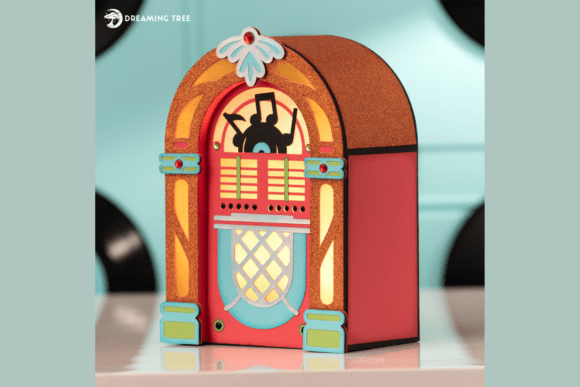
The primary value proposition of the Jivin Jukebox SVG lies in its layered architecture. A casual observer might see a retro icon, but a professional evaluator sees a sequence of interlocking components designed to create volume. The file typically includes distinct layers for the main chassis, the internal lighting effects, the record player details, and the external decorative elements like chrome accents and buttons. This separation is critical for workflow efficiency. It allows the creator to assign specific materials to specific layers without manual masking or complex weeding processes.
In practice, the design leverages the standard 12x12 inch cutting mat dimensions, which is the industry norm for most desktop die-cutting machines. The final assembled dimensions—approximately 7.75 inches in height, 5.5 inches in width, and 3.375 inches in depth—suggest a substantial presence on a tabletop without being unwieldy. This scale makes it versatile enough for a gift box lid or a standalone centerpiece. The inclusion of a PDF legend alongside the SVG file is a significant usability feature. In complex multi-layer projects, keeping track of which vector path corresponds to which physical piece can be a bottleneck. A clear legend mitigates assembly errors, reducing waste and ensuring consistency across multiple units—a key concern for entrepreneurs fulfilling bulk orders.
Material Selection and Resource Management
Successful execution of the Jivin Jukebox SVG relies heavily on precise material selection. The design specification calls for a curated palette that mimics the chrome, plastic, and glowing lights of a 1950s diner aesthetic. From a procurement standpoint, the supply list is specific:
- Cherry Cardstock (3 sheets): Likely used for the main body structure, requiring a weight capable of holding folds and tabs without collapsing.
- Black Cardstock (2 sheets): Essential for creating contrast and defining the negative spaces within the machine's interface.
- Specialty Papers: The design utilizes Cricket (blue), Pool (light blue), Copper Glitter, Silver Holographic, and Vellum in white and yellow.
The reliance on specialty papers like holographic and glitter stock introduces variables in cutting performance. These materials often require adjusted blade depths and slower cutting speeds to prevent tearing or incomplete cuts. Furthermore, the use of vellum for lighting effects demonstrates a thoughtful approach to realism; when backlit or paired with reflective backing, these translucent layers simulate the glow of vacuum tubes or neon signs. For professionals, this means the project is not just about cutting shapes but about understanding how light interacts with different media. The requirement for adhesives such as foam squares and velcro dots indicates that the assembly involves both permanent bonding and potentially removable sections, adding to the interactive quality of the final product.
Workflow Integration and Compatibility
Compatibility is a non-negotiable factor for digital assets. The Jivin Jukebox SVG is formatted for universal compatibility with major cutting software ecosystems, including Cricut Design Space, Silhouette Studio, and Adobe Illustrator. This flexibility ensures that the file can be integrated into existing workflows regardless of the hardware preference of the user. The ability to resize the project is another practical advantage. While the original design is optimized for the 12x12 format, the vector nature of SVG allows for scaling up or down to fit specific client needs, such as creating miniature versions for scrapbooking layouts or enlarged versions for stage props.
However, resizing does come with caveats. As the design scales, the tolerance for intricate cuts changes. Small tabs and slots that hold the 3D structure together may become too fragile if scaled down significantly, or conversely, too bulky if scaled up without adjusting the cardstock weight. Experienced users will recognize the need to test-cut a single complex component before committing to a full batch, especially when altering the default dimensions. The availability of a step-by-step video tutorial further supports workflow efficiency, serving as a visual standard operating procedure (SOP) that can be referenced during assembly or shared with team members in a collaborative studio environment.
Practical Applications and Market Fit
Identifying the right application for the Jivin Jukebox SVG is crucial for maximizing return on investment. For event planners and party coordinators, this design serves as a high-impact centerpiece for 50s-themed celebrations, rockabilly weddings, or music-industry galas. Its three-dimensional nature offers a tactile experience that flat prints cannot match. For educators, the assembly process provides a hands-on lesson in geometry, following instructions, and fine motor skills, making it a viable project for middle school art classes or community workshop settings.
Small business owners selling handmade goods can leverage this design for limited-edition gift boxes. The structural depth allows the box to hold substantial items, while the aesthetic appeal justifies a higher price point compared to standard packaging. The "retro" niche remains evergreen, appealing to a demographic that values nostalgia and craftsmanship. However, potential users must consider the time cost. Assembly of a multi-layer 3D model is labor-intensive. It is not a "cut-and-peel" project like a vinyl decal. Therefore, pricing strategies for finished goods must account for the assembly time, adhesive costs, and the potential for material waste during the learning curve.
Limitations and Considerations for Success
While the Jivin Jukebox SVG offers robust design features, it is not without limitations that users must anticipate. The dependency on specific paper colors means that substituting materials can drastically alter the final look. If a creator cannot source the exact "Pool" or "Cricket" shades, the visual harmony of the piece may suffer. Additionally, the use of glitter and holographic papers can leave residue on cutting mats and blades, necessitating more frequent equipment maintenance.
Furthermore, the structural stability of the final product depends entirely on the precision of the cuts and the quality of the assembly. If tabs are not folded accurately or if adhesive is applied unevenly, the 3D form may warp over time. This makes the project less suitable for environments with high humidity or rough handling unless reinforced. Users should also note that the file is provided in SVG format only; those requiring DXF or other proprietary formats for older machines may need to perform file conversions, which can occasionally introduce node errors if not done carefully.
Final Assessment
In the landscape of digital crafting files, the Jivin Jukebox SVG stands out as a well-engineered resource for those willing to invest time in assembly. It moves beyond simple decoration to offer a functional, structural challenge that rewards attention to detail. Its strength lies in the thoughtful layering, the realistic material simulation through vellum and metallics, and the comprehensive support materials like the legend and video tutorial. For professionals who understand the nuances of paper weight, adhesive mechanics, and light interaction, this file provides a reliable foundation for creating high-value, nostalgic artifacts. It is best suited for projects where the tangible quality of the object is paramount, offering a satisfying blend of technical precision and artistic expression.