Integrating the Rattleshark Articulated Fidget Toy into Professional Workflows
In the modern professional landscape, maintaining focus and managing cognitive load are critical components of productivity. Whether you are an entrepreneur navigating complex decision matrices, a developer debugging intricate code, or an educator managing a dynamic classroom, the need for effective sensory regulation tools is undeniable. The Rattleshark Articulated Fidget Toy represents more than just a novelty; it is a tactile instrument designed to fit seamlessly into high-performance workflows. By combining fluid kinematic motion with auditory feedback, this tool offers a practical method for grounding attention and reducing stress without disrupting the primary task at hand.
The Role of Tactile Feedback in Cognitive Processing
Understanding where the Rattleshark fits within a broader process begins with recognizing the function of fidgeting in adult cognition. For many professionals, idle hands can lead to mental drift. The act of manipulating an object provides a low-level sensory input that occupies the brain's background processing power, allowing the foreground resources to remain dedicated to complex problem-solving. The Rattleshark is engineered specifically for this purpose. Its segmented body mimics the fluid motion of a shark, providing a smooth, predictable mechanical resistance that is satisfying to manipulate.
Unlike static stress balls or silent spinners, the Rattleshark introduces a unique variable: sound. The integrated rattle engine creates a distinct auditory cue during movement. In a workflow context, this serves as a micro-feedback loop. When you are deep in a planning session or waiting for a compile process to finish, the rhythmic rattle can help synchronize breathing and thought patterns, effectively acting as a physical metronome for your focus. This dual-sensory engagement—touch and sound—makes it particularly effective for individuals who require stronger stimuli to maintain concentration during long periods of sedentary work.
Strategic Placement in Daily Routines
To maximize the utility of the Rattleshark Articulated Fidget Toy, consider its placement within your daily routine relative to specific tasks. The design philosophy of this tool supports three distinct phases of workflow integration: preparation, execution, and transition.
Pre-Task Preparation and Warm-Up
Before diving into a high-stakes meeting or a creative brainstorming session, the brain often requires a moment to shift gears. Using the Rattleshark during this transition period can serve as a ritualistic anchor. The fine-tuned design, featuring a fixed chin overhang and defined teeth, ensures that the manipulation feels premium and deliberate. Spending sixty seconds articulating the segments before opening a laptop can signal to the brain that it is time to focus, creating a psychological boundary between leisure and work.
Active Execution and Flow State
During the execution phase, the toy acts as a passive companion. Because it includes a dedicated ring area on the tail section for keychain attachment, it is inherently portable. You can keep it attached to your bag or lanyard, ensuring it is always within reach when a difficult concept arises. The high-resolution details and optimized segments allow for one-handed operation, meaning you can hold a phone, turn pages, or rest your other hand on a keyboard while manipulating the shark. This compatibility with other tools ensures that the fidgeting does not become a distraction but rather a supportive action that sustains momentum.
Post-Task Decompression
After completing a rigorous project or making a significant business decision, the nervous system often remains in a heightened state. The audible "rattle" and the repetitive motion of the articulated segments provide a mechanism for decompression. This helps in closing the cognitive loop of the completed task, allowing you to mentally disengage and recharge before starting the next item on your agenda. Consistency in using such tools can lead to better long-term stress management and reduced burnout.
Technical Considerations for Creators and Makers
For the segment of the audience involved in 3D printing, product design, or digital fabrication, the Rattleshark offers valuable insights into design for manufacturing (DFM) and file optimization. The model is available in fine-tuned STL and 3MF formats, showcasing how digital assets can be prepared for both single-material and multi-material printing processes.
When integrating this model into your own printing workflow, attention to slicing parameters is crucial. The creator has implemented specific reverse engineering protection, which may trigger errors or warnings during the slicing phase. It is vital to understand that these alerts are intentional and will not affect the print quality. A practical implementation tip here is to always review the slicing preview to ensure a successful toolpath before initiating the print. This step reinforces a broader lesson in quality control: never rely solely on automated software feedback; visual verification remains the gold standard in production.
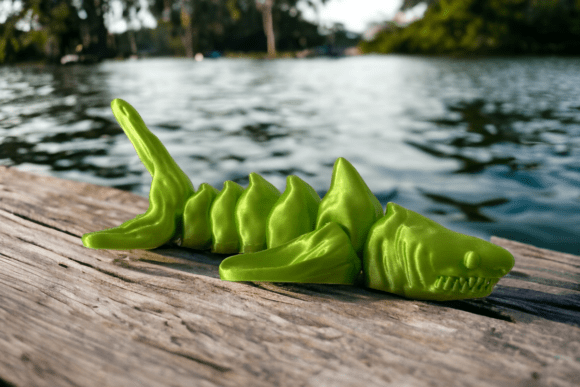
Furthermore, the choice of filament plays a significant role in the final user experience. The model is beautifully rendered in various materials, from shimmering silk white to high-gloss green. For professional environments, selecting a filament that matches your brand colors or office aesthetic can enhance the tool's acceptance as a legitimate workplace asset rather than a toy. The vibrant display options allow for customization that aligns with personal or corporate identity, adding a layer of professionalism to the object.
Compatibility and Long-Term Usability
Sustainability in a workflow tool depends on its durability and ease of maintenance. The Rattleshark's articulated design relies on precise tolerances between segments. Over time, friction can alter the feel of the movement. However, the high-quality nature of the print files ensures that, when printed correctly, the joints remain robust. For those purchasing pre-printed versions, understanding the material properties is key. PLA offers crisp details and a sharper rattle, while PETG might provide slightly more flexibility and durability for heavy daily use.
The keychain compatibility extends the tool's utility beyond the desk. For field workers, real estate agents, or educators who move between locations, having a consistent sensory tool attached to your keys ensures that your coping mechanisms travel with you. This portability supports consistency in behavior modification techniques, regardless of the environment. Whether you are in a co-working space, a client's office, or a home studio, the presence of the Rattleshark provides a familiar tactile constant.
Optimizing the Sensory Experience
To fully leverage the benefits of the Rattleshark Articulated Fidget Toy, users should experiment with different manipulation styles. Some may prefer slow, deliberate articulation to aid in deep thinking, while others might find rapid flipping helpful for burning off excess energy during a conference call. The specialized tooth-shaped mouth and distinct dorsal fins offer multiple grip points, allowing for varied interactions. This versatility ensures that the tool grows with the user's changing needs.
Additionally, the auditory aspect should be managed according to the social context. While the rattle is a feature, it can be a distraction in quiet libraries or intense negotiation rooms. In such scenarios, the user can opt for a slower manipulation speed to minimize sound, demonstrating the tool's adaptability to different social contracts and professional norms.
Conclusion: A Tool for Modern Productivity
The integration of the Rattleshark into a professional workflow is not about play; it is about performance. By providing a reliable, high-quality tactile outlet, it supports the cognitive demands of modern work. From the initial slicing precautions for makers to the daily stress-regulation routines of executives, this articulated figure serves as a bridge between physical sensation and mental clarity. Its design reflects a deep understanding of user needs, offering a solution that is both aesthetically pleasing and functionally robust. For anyone looking to refine their focus and manage their workflow more effectively, the Rattleshark stands out as a practical, well-engineered asset.